Sunday, February 20, 2022

I Suck at Time Management

      I'll admit I have a flaw. Trying to manage time, especially with a big project that spans eight weeks, will be very difficult unless I establish a schedule right from the beginning. I am determined to carefully plan out everything in order to not leave everything until the last minute and sacrifice the quality of my film opening as a result of it. There are seven weeks left until our final due date: April 4th, 2022. In addition, there are four main stages I must for through which include pre-production, production, post-production, and editing.

     So far, I have been focusing on the planning and research side of the film opening. My partner Julia and I have finally decided on our storyline and how we want to structure our film opening. Our next step is to research our character more and create layouts, storyboards, etc. of the full two minutes of our film opening. This is our ideal schedule:

Week 2/21-2/27

  • Research and establish the protagonist (her underlying purpose, conflicts, motivations)
  • Create mood boards for the film to create a cohesive aesthetic
  • Start drafting storyboards
  • Create a clearer layout of the film opening

Week 2/28-3/6

  • Continue making storyboards
  • Write the script
  • Make decisions on casting
  • Figure out filming locations and mise-en-scene

Week 3/7-3/13

  • Research lighting and how it is used in film
  • Get materials needed for filming ready
  • Film for the rest of the week
  • Research the editing software we are using more

Week 3/14-3/20

  • Editing 101, focus on editing the opening
  • Learn about cool effects we can use in our opening
  • Decide what fonts we want to use, how we want to animate the film's title

Week 3/21-3/27

  • Do any necessary reshoots
  • Start the creative critical reflection
  • Finish the editing process once and for all

Week 3/28-4/1

  • Finish and edit the creative critical reflection 
  • Have a meeting with partner on what went well and what could have been improved
  • Jump for joy

Week 4/2-4/4

  • Finally submit everything we put our blood, sweat, and tears into
  • Three days of extra time to leave room for unexpected setbacks
     Obviously, this schedule does not cover all parts of the process that will go into the film opening considering my partner and I are still learning, and we have never done anything like this before. Hopefully, this schedule will help us stay organized since we have to hit certain targets each week. My takeaway from this is that I need to clear my schedule for the next eight to nine weeks.


A Notion page I made to keep myself organized and make sure the process of making this film opening stays on track.


I'm Having Writer's Block...and I'm Not Even a Writer

      This is so much harder than I thought it would be. Coming up with a storyline for our short film opening is taking longer than expected. There are so many things my partner and I want to do, but we have to limit ourselves to our genre characteristics. In addition, it is hard to make a storyline that differentiates from other coming-of-age movies but still stays in the genre. After much consideration, we have narrowed our troubles down to two main causes: thinking of the storyline as just the short film opening and coming up with a storyline that is not identical to other popular coming-of-age movies.

     It was extremely difficult to come up with a plot when we were just brainstorming what we wanted to include in the short film opening alone. Consequently, seeing our storyline as just being in a two-minute timeframe limited our ideas. This is because we weren't able to develop characters, their motivations, their storylines, or their purposes, which are what drives a character's actions. Without thinking of the storyline as a whole, our protagonist would feel very two-dimensional when instead they need to be intriguing, especially in a coming-of-age movie where the plot centers around the character's emotions. Shifting our way of thinking can be compared to seeing the light at the end of the tunnel since all our ideas started rolling in right after the switch. From now on during the pre-production process, we will see this whole project as a full film in order to better develop our short film opening. 


A very accurate depiction of what coming up with a storyline feels like.

Friday, February 18, 2022

Represent!

      So we've decided on our genre and now it's time to look at who our film will be targeting. Analyzing the target market of the coming-of-age genre would help us include features in our short film that will appeal to the audience. Ideally, the coming-of-age genre targets a teenage/young adult audience since they can easily identify themselves with the characters. Teenagers are going through the stage of life where they are developing into adults which makes them feel represented in the media. Looking at films like The Perks of Being a Wallflower, The Breakfast Club, Lady Bird, The Edge of Seventeen, you can see how all the protagonists are teenagers. In addition, all these examples constantly use school as a setting, which again represents the idea of youth. While the coming-of-age genre targets teenagers from 12-18 years of age as a whole, females are more likely to go see these movies since it aligns more with their interests and is able to emotionally connect to characters in an easier manner.

     To make our protagonist likable, it is important we consider typical characteristics given to teenage girls in films. This means making our protagonist seem like a normal, quirky teenage girl so more audience members are able to sympathize with her. Our protagonist should be facing some sort of hardship that exposes her vulnerable side and humanizes her. Audiences love seeing their favorite characters make mistakes and grow, so our female protagonist should do just that to represent what being a teenager is like. We also want to include a unique characteristic that differentiates our protagonist from other people in the film; for instance, we are making our protagonist amazing at writing. Our character is made even more three-dimensional and interesting to the audience if she has something to prove. Here are a few examples of female protagonists in successful coming-of-age films who meet these characteristics, whom we can take inspiration from when creating our own character:


Lady Bird

The Edge of Seventeen

Booksmart

Clueless

CITATIONS

“Target Audience Research.” Prezi.com, https://prezi.com/u-mzr7kqffc7/target-audience-research/?frame=987f3582c44f2b3505a3919aa8e66f5f6f626876.


Wednesday, February 16, 2022

What Makes a Coming of Age Film?

      My partner Julia and I have been trying to decide what genre we wanted to go for in our short film opening and decided to further research the coming-of-age genre. This genre centers around teenage protagonists and covers a rite of passage storyline. The coming-of-age genre seems perfect for our short film since our teacher always tells us to write what we know, and there's nothing we know better than being a teenager going through constant angst. This genre promotes self-discovery and growth since it shows a transition from childhood to adulthood. The coming-of-age genre relies on dialogue, character growth, and social commentary as a method of storytelling. The dialogue really helps the audience gain a deeper understanding of the emotions of the characters since they are expressing how they feel. A common conflict the teenagers in this genre face is man versus self, which is a more familiar type of conflict to write. The coming-of-age genre will take the audience along on an emotional or spiritual journey where the main characters grow as a result of issues and emotions. For further reference, we looked at a popular, classic coming-of-age film:

The Breakfast Club (1985)

     One of the most classic coming-of-age films is The Breakfast Club directed by John Hughes. The opening scene includes all the credits including the director, main actors, producers, editors, and production designers against a black screen before the actual shots are shown. As for sound, the film uses a voiceover where one of the main characters provides background information on the setting of the film (date, time, location). The voiceover also discusses a common characteristic included in teenage movies: cliques. Immediately from the start, there is an established social caste system that will differentiate the characters from each other. There is an establishing shot of the school and the following clips are implied to be all around the school. The Breakfast Club uses an interesting technique where they focus on specific details throughout the school, rather than the setting as a whole. For instance, they will zoom into the writing of a particular locker or show a specific poster hung in the school rather than just showing classrooms and hallways. The voiceover combined with the composition of the shots is a technique I will definitely keep in mind when filming my own short film. As the voiceover comes to an end, the main characters all arrive at the school one by one, and the dialogue they have before they enter the school helps bring a little insight as to who they are but still keeps the audience curious as to why they are all there on a Saturday. The viewing of this film opening (video below) has inspired me to include a catchy song as non-diegetic sound, utilize voiceover or dialogue as a way to build any characters, focus on specific details of the mise-en-scene, and build up a vague background story to keep the audience interested. 


Sources:

Kathryn ButtKathryn is an MA graduate in Film and Television from The University of Bristol. After moving from the depths of the countryside. “What Makes a Coming-of-Age Film? (Genre Series).” Raindance, 13 July 2021, https://raindance.org/coming-of-age-genre.

MasterClass. “Coming-of-Age Movies: What Is the Coming-of-Age Genre? - 2022.” MasterClass, MasterClass, 24 Sept. 2021, https://www.masterclass.com/articles/coming-of-age-movies#10-notable-comingofage-movies.

Sunday, February 13, 2022

The Start of A New Chapter

      And so it begins, the AICE Media Studies portfolio project that my class has been leading up to all year. I'm not going to lie, it seems very intimidating but I did get a jolt of excitement when looking at the rubric and thinking of all the possibilities. I have decided to undertake this project with a partner, and I feel as if our similar interests will aid in creating a film opening I am proud of. But first, we must do the hardest part of the project: the brainstorming session. Watching numerous films growing up has caused me to have so many ideas that I do not know where to even start. The genres that come to mind are drama, horror, and my personal favorite dystopian. I feel as if creating a dystopian film would be a challenge considering it requires a lot of world-building and a bigger budget to actually look cool. My partner Julia and I have already discussed some elements we could build our opening around considering we love reading. One of our favorite book openings of all time is from It Ends With Us by Colleen Hoover, so maybe we can draw some inspiration from her work to get the ball rolling. Maybe our protagonist can be a writer who gets consumed by her work or a writer who gets sucked into her stories. The possibilities are endless, so our next step is to meet up, do some research, and come up with a plot for our film. I am thrilled to see how it turns out and document the whole process on this blog to see how we grow along the way. 

Wednesday, February 9, 2022

Music Marketing Blog Post #2

Research

    We began the project by putting together case studies of existing music artists and researching how they marketed their albums, how they distributed their music, and the history behind their record labels. The four artists we looked at were Childish Gambino, Tyler the Creator, Lil Nas X, and Mumford and Sons. We chose to look at two record labels, one larger more established one and a more independent one. We wanted to make sure that we saw how different labels handled distribution and marketing depending on their size, so we chose Columbia Records and Glassnote Records. A prominent trend in how music is distributed is through digital distribution. Streaming platforms and digital download to the point that some artists only release their music digitally (Lil Nas X). While CDs and Vinyl still exist, artists are steering away from using them as methods of distribution. Another trend in marketing was digital marketing. Music artists would rely on having a strong social media presence to interact with fans and tease their albums. Childish Gambino even went as far as making an app called PHAROS that would play music videos from his concept album "Awaken, My Love!" All the artists researched used music videos to generate some buzz for their albums, which is why it makes sense that we created one for our campaign. After compiling all the research, it was clear that our marketing and distribution strategies needed to be suited for the 21st century, and revolve more around social media. Attached below is a link to our research:

https://docs.google.com/document/d/1pV6Og6k7H-qvunm2OGy6C8IUUJs3dq12F4Mgg_jBJrc/edit?usp=sharing

Brainstorming/Planning

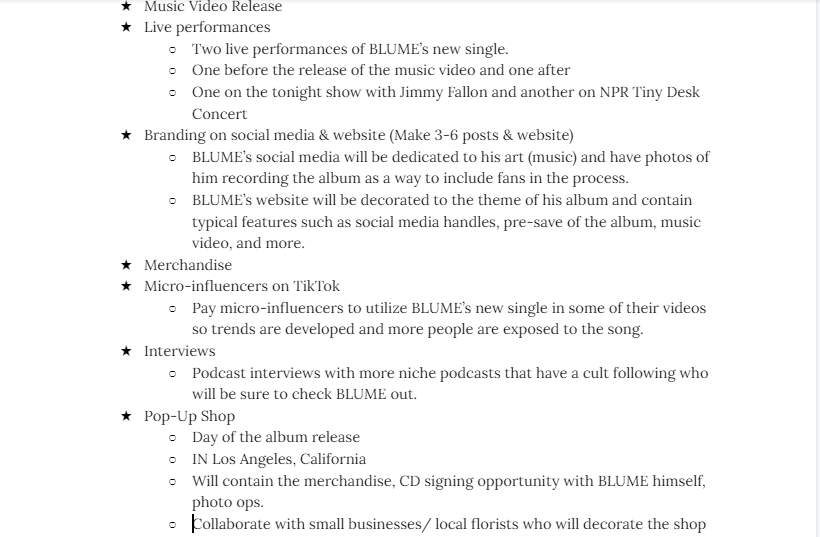
    The next portion of our project was planning out our marketing campaign and how we wanted to distribute music. Right off the bat, distribution was going to be done digitally, but we were also going to incorporate CD and Vinyl to make our artist's music more widely available. It was important to use a method of distribution that our target market mostly uses, which is digital distribution. We planned all our activities around our target market which was people who like the R&B Soul or Funk genre, as well as people aged 14-35 who live in Los Angeles California. Since this age range primarily uses social media, we wanted to do branding through popular apps like TikTok, Instagram, and Twitter. It was very important to our group that we developed a consistent theme for our campaign. We decided to name our artist BLÜME, and create a spring theme where any visuals included flowers, pinks, and greens. This theme was kept in the creation of our music video as well. We planned to make a promotional and artistic music video that showcased BLUME. We created a storyboard that showcased what we wanted our music video to look like (See below). Our group divided and conquered in order to get work done efficiently, half of us focused on the marketing plan and the other half on the music video. After a session of brainstorming, we decided to include billboards, merchandise, a music video release, live performances, interviews, promotion by TikTok influencers, and a pop-up shop in our marketing campaign. These ideas were based on research we collected from our case studies and trends we have seen in media.


Production

    The production process took only two days. Since we did all our planning beforehand and had a clear vision of what we wanted our music video to look like, all we had to do was film. We decided to film at a local park nearby to go with the spring theme since the park had a lot of greenery and hills. We filmed using an iPhone camera and compiled shots around the park where the artist was just surrounded by greenery. Since we wanted to market and show off BLUME, he was in all of the shots of the music video. In addition, we also filmed at a group member's house for the beginning and end of the video. We really wanted the first and last shot to be BLUME surrounded by flowers, so we got a piece of green poster board and attached multiple faux daisies to it. We then cut a hole in the middle of the poster board where BLUME put his face in. This shot was filmed in the bathroom and I feel that it really pulled the music video together. 


Post-Production

    The post-production process consisted of editing all the clips we shot together in order to make our vision come to life. We used different colored filters on the video in order to give it the more artistic feel we were going for. We also played around with some transitions and were even able to clone BLUME in the music video. The hardest part of the editing was syncing the video with the actual song. However, with careful attention to detail, we were able to sync the video and music correctly. It was also important that the cuts between the shots matched the slower tempo of the song. The editing process took about two days in total to get completely right. 


Presentation

    As the final step of our project approached, we prepared to present through the creation of a Canva slideshow presentation. We wanted to make our presentation as engaging and on-theme as possible which meant creating lots of graphics as examples of our activities, and decorating the slides as the campaign theme: spring. We divided up the presentation so everyone in the group talked about the marketing activities and how they would impact our target audience. Practicing the presentation beforehand gave us the confidence and professionalism to present it in front of the class. We were also prepared for any questions that would be asked to weaken our campaign since we knew a lot about how we wanted our artist to be perceived. The slideshow presentation had the flowers, pink, and green theme and kept the information to a minimum so most of the information would be coming directly from our group members. 


Reflection

    This project taught me a lot in terms of how to work in a group and collaborate with others. Since there were four group members, it was important that we could arrange a time we all could meet or talk about the progress of our project. Working in a group that was very motivated showed me that in group projects I do not always have to be heavily involved in all parts of the project. I must put trust into my other group members and divide and conquer so we get more work done. Another thing I learned was that I really have to manage my time better. While the project was turned in on time, it would have been less stressful if we used our class time productively and got most of our work done there. Although we were given weeks for the project, I learned that things must be done in sections rather than all at the same time. This project will help in developing my Cambridge Portfolio since I now know the importance of research which I underestimated before. Researching for a good period of time made the project and brainstorming process much more smooth sailing. I will also make sure to create a schedule at the start of the portfolio project in order to make sure everything is being completed on time. The music video portion of the project also taught me to be more creative when it comes to creating videos, to capture the audience's attention. As a result, I will try to think outside of the box when it comes to my portfolio project and make the audience feel as if they want to keep watching.

Friday, January 28, 2022

Music Marketing Blog Post #1

There are many steps that go into curating an effective music marketing plan. The first step we took was conducting market research for three days. We looked at different music artists’ marketing campaigns as well as how they distribute their music. Looking at examples of Childish Gambino, Mumford & Sons, Lil Nas X, and Tyler the Creator, we were able to come up with ideas and notice patterns found in niche and viral marketing. Lil Nas X’s approach was drastically different from the three other artists since he heavily relied on buzz marketing to promote his music. His music videos and social media posts contained controversial topics that motivated conversation whether good or bad. As a result, Lil Nas X kept his name in the media for a long time. Many people were exposed to his name and encouraged to check out his music videos and music to see where the controversy lay. Childish Gambino and Tyler the Creator target a more niche market, which means while their marketing reaches fewer people, they have a stronger, more loyal following. Consequently, these artists were able to get more creative with their campaigns and lean into more of an artistic approach since their fans would not stop listening. For instance, their billboards would contain phone numbers to call where people could listen to sneak-peeks of their new singles, they would drop surprise albums on random websites, and their albums were very visual with many music videos and concept art. A pattern seen from all these artists in terms of distribution is the use of streaming platforms such as Spotify, Apple Music, YouTube Music, etc. Any music would be available for purchase digitally, and cross-convergence would be embraced with CD’s and vinyls. 

Next, we started brainstorming what we wanted our campaign to look like. Our plan contained a mixture of digital and buzz marketing. A big thing we wanted to focus on was the branding of our artist, BLÜME. This meant coming up with a cohesive color palette and theme in our campaign. After brainstorming, we decided on using kelly greens and different shades of pink as well as colorful flowers to be associated with   BLÜME. As for our marketing campaign, we came up with many ideas: billboards, Spotify advertisements, music video releases, live performances, interviews, a strong social media presence, merchandise, collaborations with micro-influencers on TikTok, and a pop-up shop. These ideas were derived from our market research, research on different forms of marketing that we did as a class, and prior knowledge on marketing. We discussed how to execute these ideas and decided that one of our biggest events would be the music video release and the pop-up shop. Having to produce the music video ourselves, we decided on taking an artistic and promotional approach that would fit the theme of the album. Our group knew we wanted to incorporate many flowers and bright colors in the video, so we tried to pick a shooting location that would allow us to do that. We settled on a local park that has many hills and greenery. Additionally, we made a storyboard and planned out the different shots we wanted to include in our video. 

Throughout the course of this project, we have encountered some challenges that could have been unavoidable. The biggest problem was time management. Although we are back on track and have a majority of the project complete, we should have better organized our time so we had more time to edit and account for any mishaps. Being absent from class for one day alone set us back, and we could have finished sooner if we truly focused on the project without getting distracted. Our next steps are to shoot the music video and edit it, as well as transfer our marketing plan into a presentation form. The music video shoot will be two days, one for the majority of the video, and the second day for any re-shoots. The editing process will also be done over the course of one day. Since the presentation has already been started, and the information has already been found, it will not take long to complete. Our project is on track to be finished on time and is overall a campaign to be proud of.


The picture illustrates the planning process of the marketing campaign activities.

A case study of the record company Glassnote Records and the marketing/distribution plans of its artists.

A logo of the artist we will be promoting, that exhibits the theme and colors that will be repeated throughout the campaign.

Below are a collection of sketches that form a storyboard of what the music video will look like:


That's A Wrap

      Surprise!!! I am still here and I am back for one final post. As you may have already seen, the film opening is completed and now read...